Here, I talk about the various safety features introduced this decade
Safety Car
It was first used in Formula One at the 1973 Canadian Grand Prix. Its called upon when the conditions are deemed too dangerous to drive. Bernd Maylander is the current driver of the Safety Car. In order t indicate that the safety car has been called, a board with letters SC is put along with the yellow flags. It generally joins ahead of the leader of the race, but there have been instances where it has lead to confusions, one primary example being the inaugural SC race itself, wherein the race winner was decided hours after the race had completed.
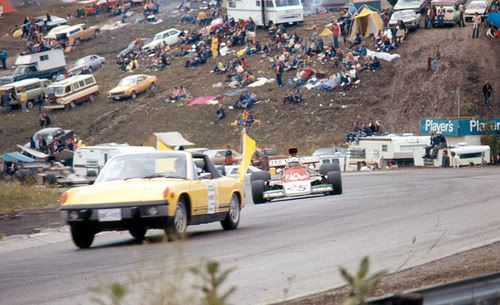
©http://i1004.photobucket.com/albums/af164/EB_Chris/Misc%20Racing/1973SafetyCar.jpg
Repercussions: The entire field gets bunched up behind the SC, much to the fan’s delight as it increases the excitement in the race, but it is always disadvantageous to those that have built a strong gap to the one behind as all the hard work ends up being nothing. It can be considered synonymous to a coin though, as sometimes it helps a driver and sometimes is a disadvantage to the driver.

Jackie Stewart
One might wonder… “Is this a safety device or safety feature?” Nope, it is neither. It is Formula One Great and triple world champion Jackie Stewart. As per the Formula 1 website, during his time, the chances of getting killed were 2/3rds over a 5 year period of racing. He became one of the forerunners in pushing towards heightened safety standards, with him even saying once that he would like to be remembered for his work in upgrading safety. With initial opposition in the late 60s, he generally got his voice to be heard, and this lead to what safety is today over time.
©http://www.formula1.com/wi/597x478/manual/gallery_image_main_127_3.jpg
One might wonder… “Is this a safety device or safety feature?” Nope, it is neither. It is Formula One Great and triple world champion Jackie Stewart. As per the Formula 1 website, during his time, the chances of getting killed were 2/3rds over a 5 year period of racing. He became one of the forerunners in pushing towards heightened safety standards, with him even saying once that he would like to be remembered for his work in upgrading safety. With initial opposition in the late 60s, he generally got his voice to be heard, and this lead to what safety is today over time.
©http://www.formula1.com/wi/597x478/manual/gallery_image_main_127_3.jpg
Track safety
 Many regulations with regards to track safety were introduced during this time, right from double crash barriers, pre- race circuit inspections, minimum height grass verges, straw bales being banned, wall separation between track and pit lane to a minimum distance of 3 metres between spectators and the outer fence in 1970. By 1974, safety walls around the circuit became mandatory, followed by marshals and medical service personnel (with proper Prior training) getting mandated the following year. Service roads were also to be provided for ease in transport.
© formula1.com
Cockpit
 Cockpits were needed to be designed such that the driver could escape out within 5 seconds in the event of a crash/ incident. A 6 point safety harness (2 shoulder straps, with 2 belts between the legs through which another 2 straps pass through) for the driver was made compulsory in 1972. A more prominently placed and better fire extinguisher was to be present by the decade end along with the implementation of safety structures around the dashboard and pedals.
Image shows a 5 point harness : .
©http://en.wikipedia.org/wiki/File:Lotus_22_inside_detail.jpg
Overtaking Code of Conduct (©http://www.f1pulse.com/schumster/insights/201004232/f1-overtaking-code-of-conduct)
In order to make overtaking more safe, the following rules were introduced:
a) A car that is alone on the track can use the entire width of the track, however, as soon as it is caught by a car that is about to lap it, the driver must allow the faster car to go through at the first available opening. If for some reason the driver that has been caught up is unable to make full use of the rear mirrors, the flag marshals will wave the blue flag, to indicate that the faster wants to overtake. A driver that chooses to ignore the blue flag would be reported to the Stewards.
b) According to the situation, a driver can overtake the car in front of him, either from the right side or the left side. However, moves that could possibly obstruct other drivers, like the change of direction more than once to defend a position, deliberately squeezing the car beyond the edge of the track or any other unusual change of direction are strictly forbidden. Any driver found guilty of using such a method of driving would be reported to the Stewards.
c) The drivers should use the track at all times. To avoid any confusion:
i) The edges of the track are marked with white lines and are considered to be a part of the track; however, the kerbs are not a part of the track.
ii) The driver will be considered to have left the track if no part of his car remains in contact with the track.
In a situation where the driver goes off the track, and without prejudice to point d below, he may rejoin, only when it is safe and without gaining any advantage.
d) Drivers committing serious mistakes repeatedly or seem to have a problem with keeping the car on the track would be reported to the Stewards and could result in penalties up to and including the exclusion of the driver in question.
At any given time during the season, the driver is expected to follow these rules. Any driver who deliberately appears to break any of these rules to gain advantage at any stage in the race or the season could be penalised by the sport’s governing body.
Note: Super licenses were made mandatory in 1978 in order to drive in F1.